

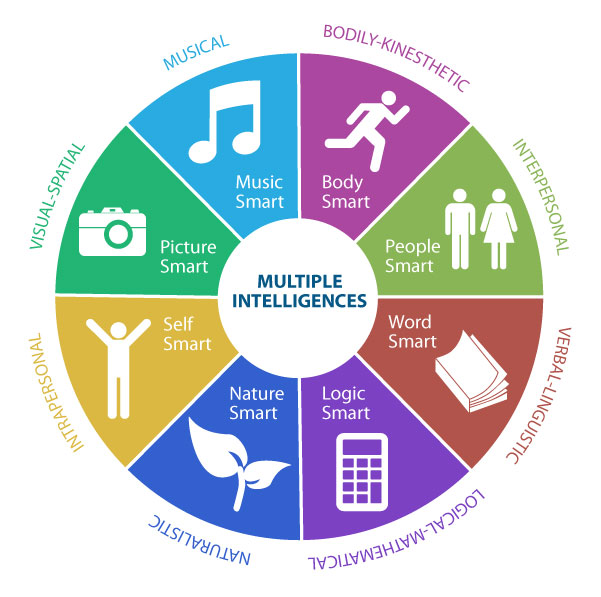
Visual-Spatial
Verbal-Linguistic
Musical-Rhythmic
Logical-Mathematical
Interpersonal
Intrapersonal
Naturalistic
Bodily-Kinaesthetic


Different Types of Developments:
– Studies and formulations have found a unique pattern of language development in children. Children develop it more or less, as per their abilities or surrounding atmosphere, but going through this language pattern will help you recognize, as a dependable parent judging your own expectations for your child. Expecting a lot from a child put him under a pressure, which can be harmful to his growth and future. Children go through a number of different stages as language develops, from the earliest stage of producing cooing sounds through being able to produce complex, multi-word sentences.
1) Babbling (3-9 Months):
The first stage of language development is known as the prelinguistic, babbling or cooing stage. During this period, which typically lasts from the age of three to nine months, babies begin to make vowel sounds such as oooooo and aaaaaaa. By five months, infants typically begin to babble and add consonant sounds to their sounds such as ba-ba-ba, ma-ma-ma or da-da-da.
2) Single Words (10-13 Months):
The second stage is known as the one-word or holophase stage of language development. Around the age of 10 to 13 months, children will begin to produce their first real words. While children are only capable of producing a few, single words at this point, it is important to realize that they are able to understand considerably more. Infants begin to comprehend language about twice as fast as they are able to produce it.
3) Two Words (18 Months):
The third stage begins around the age of 18 months, when children begin to use two word sentences. These sentences usually consist of just nouns and verbs, such as “Where daddy?” and “Puppy big!”
4)Multi-word Sentences (2 years):
Around the age of two, children begin to produce short, multi-word sentences that have a subject and predicate. For example, a child might say “Mommy is nice” or “Want more candy.”
As children age, they continue to learn more new words every day. By the time they enter school around the age of five, children typically have a vocabulary of 10,000 words or more.
– Children aren’t just growing physically during early childhood, they are also developing new cognitive abilities as they mature. Early childhood is not only a period of amazing physical growth; it is also a time of remarkable mental development. Cognitive abilities associated with memory, reasoning, problem-solving and thinking continue to emerge throughout childhood.
- Stages of Cognitive Development
Stage-1 : The Sensorimotor Stage (0-2 Years):
A period of time between birth and age two during which an infant’s knowledge of the world is limited to his or her sensory perceptions and motor activities. Behaviours are limited to simple motor responses caused by sensory stimuli.
Stage-2 : The Preoperational Stage (2-6 Years):
A period between ages two and six during which a child learns to use language. During this stage, children do not yet understand concrete logic, cannot mentally manipulate information and are unable to take the point of view of other people.
Stage-3 : The Concrete Operational Stage (7-11 Years):
A period between ages seven and eleven during which children gain a better understanding of mental operations. Children begin thinking logically about concrete events, but have difficulty understanding abstract or hypothetical concepts.
Stage-4 : The Formal Operational Stage (12-18 Years):
A period between ages twelve to adulthood when people develop the ability to think about abstract concepts. Skills such as logical thought, deductive reasoning and systematic planning also emerge during this stage.
– Social-Emotional development is the growth of a child’s ability to feel and express an increasing range of emotions appropriately. Social development is the growth of a child’s ability to relate to others and become independent.
At Birth
Babies begin to learn as soon as they are born, but at this stage their behaviour and communication with adults are limited. Babies cry to make their needs known and are peaceful when those needs are met. At this stage babies:
Depend on parents/carers
Sleep a lot
Likes to be undisturbed
Have rooting, sucking and swallowing reflexes
Cry when hungry, unattended to or in pain
Startle to noise, and turn to light, providing it is not too bright.
1 Month
At this stage babies smile spontaneously, but they begin to smile in happenings outside themselves from 4-8 weeks. They learn to smile to your voice and face and are also attracted to the movement of your face. At this stage babies:
Cry for their needs to be attended to
Will turn to mother’s breast
Briefly looks at a face
Sleeps most of the time when not being handled or fed
Grasp a finger if the hand is opened and the palm is touched
Will quieten or smile in response to your voice.
2 Months
From 2 months babies have less primitive reactions and gradually learn a range of responses and behaviour. These are the results of both physical maturation and the beginning to explore the environment. At this stage the baby is capable of having ‘conversations’ with the carer. These are a mixture of gestures and noises, but follow the pattern of a conversation in that one person is quiet while the other speaks. At this stage babies:
Explore using their five senses
Sleep less during the day and more during the night
Stop crying when they are picked up
Differentiate between objects, and begin to tell one face from another
Follow your face when it moves
Smile and become more responsive to others.
3 Months
At this stage babies take a lot of interest in their environment. Physical maturation continues rapidly. When they hear different sound babies turn their heads in response to see what people are doing. They are rapidly beginning to learn new social skills from the people around them. Around this stage babies:
Use sounds to interact socially and reach out to human face
Respond to friendly handling and smile at most people
Become more oriented to their mother and other carers
Looks at mother’s or carer’s face when feeding
Are able to show an increasingly wide range of feelings and responses including pleasure, fear, excitement, unhappiness and contentment
Have some awareness of the feelings and emotions of others
Begin to connect what they hear with what they see.
6 Months
Development at this stage is very rapid. Babies are awake for much longer periods by 6 months. Babies laugh, show excitement and delight and will also show likes and dislikes. Around this age infants:
Reach out for familiar people and show a desire to be picked up and held
Begin to be more reserved with, or afraid of, strangers
Show a marked preference for their main carer(s)
Like to play peek-a-boo
Smile at their own image in a mirror
Become more aware of themselves in relation to other people and things
Look at their hands and feet with interest
Stop crying when communicated with.
9 Months
By this age, infants will have formed strong attachments with their main carer(s). They will also usually have begun to move around independently. They take pleasure in playing with their careers and learn a great deal from this interaction. Around this age infants:
Show fear of strangers and need reassurance when in their company, often clinging to the known adult and hiding their face in them
Play peek-a-boo, copy hand clapping and pat a mirror image
Clearly distinguish familiar people and show a marked preference for them
Cry for attention to their needs, but also they use their voice to attract people to themselves
Put hands around a cup or bottle when feeding
Show pleasure and interest at familiar words
Understand ‘No’
Begin to respond to their own name.
12 Months
By this stage, most children have started to stand independently and possibly have begun to walk. They can pick up small objects and to explore their environment around them. By this age infants:
Can distinguish between different members of the family and act socially with them
Will wave goodbye
Like to be within sight and hearing of a familiar adult
Show rage when thwarted
Know their own name
Will obey simple instructions
May be shy with strangers
Copy actions and sounds of adults or children.
15 Months
At this stage toddlers use their main carer as a safe base from which to explore the world. They are anxious and apprehensive about being physically separated from them, and tend to be very much ‘under the feet’ of their careers. They are very curious about their environment and their exploration of it can lead to conflicts with their careers. By this stage children:
Begin to distinguish between ‘you’ and ‘me’, but do not understand that others are individuals just like themselves
Can point to members of the family
Tend to show off
Have a sense of ‘me’ and ‘mine’ and begin to express themselves
Throw toys when angry
Show interest in other children
Show jealously of the attention given by adults to other children
Have an interest in strangers, but can be fearful or wary of them
Are emotionally changeable and unstable
Hold a cup and drink without assistance
Help with dressing and undressing.
18 Months
Children are very egocentric at this stage. They are often defiant and resistant at this stage. They have only recently discovered themselves as separate individuals. Their defiant behaviour can be seen as an attempt to protect themselves and their individuality. At this stage children:
Show intense curiosity
Tend to follow their carer around, be sociable and imitate them by helping with small household tasks
Are trying to establish themselves as members of a social group
Imitate and mimic others during their play
Show some social emotions, for example sympathy for someone who is hurt
Cannot tolerate frustration
Have intense mood swings, from dependence to independence, eagerness to irritation, co-operation to resistance
Are still dependent on familiar carer and also often return to a fear of strangers.
2 Years
Children at this stage are capable of a wide range of feelings and able to empathise with the feelings of those close to them. For example if their carer is upset, they are capable of trying to comfort them. They are able to use symbols in language and these newly acquired linguistic skills enable children to achieve new levels of social development. At this stage children
Will try to be independent
Will ask for food
Demand their carer’s attention and want their needs to be met immediately they make demands
Sometimes have tantrums if crossed or frustrated
Are capable of being loving and responsive
Can point to parts of the body and other features when asked
Are possessive of their own toys and objects, and have little idea of sharing
Tend to play parallel to other children, engage in role play, but are beginning to play interactive games
Join in when an adult sings or tells a simple story.
3 Years
Children are usually happier at this stage of their development and are more contented than during their previous years. They have gained a certain amount of physical and emotional control. This can lead to more settled feelings and more balance in the way they express them. They are generally friendly and helpful in their manner to others. At this stage children
Can wait for their needs to be met
Can feel secure when in a strange place away from their main carers
Are less rebellious and use language rather than physical outbursts to express themselves
Enjoy make-believe play both alone and with other children
Have an ability to share things and to take turns
Can show affection to younger siblings
Want the approval of loved adults
Project their own experiences onto dolls and toys
May have imaginary fears and anxieties.
4 Years
At this stage children are constantly trying to understand and make sense of their experiences and of the world around them. By this age children
May have one particular friend
Are capable of being very sociable
Play with groups of children
Can take turns but are not consistent about this
Are developing a strong sense of past and future
Are able to cope with delay in having their needs met
Can be confident and self-assured
May be afraid of the dark and have other fears
Turn to adults for comfort when overtired, ill or hurt.
5 Years
At this age children achieve a level of balance, self-containment and independence. They are usually friendly, willing to talk to anyone, and are able to be polite. By this age children
Want approval of adults
Prefer games of rivalry to team games
Enjoy brief separations from home and carers
Show good overall control of emotions
Show a desire to excel, and can be purposeful and persistent
Boast and show off
Enjoy co-operative group play, but often need an adult to arbitrate
Still respond to discipline based on bargaining
Are developing a sense of shame
Argue with parents when they request something.
6-7 Years
At this stage children grow steadily more independent and are sociable. They are generally self-confident and friendly; they are able to co-operate in quite sophisticated ways with adults and children. Their peer group becomes increasingly significant to them. At 6 years children
May have spells of being rebellious and aggressive
Are often irritable and possessive about their own things.
At 7 years children
Are more aware of gender characteristics
May be so enthusiastic for life that carers have to guard against them becoming overtired
Become very self-critical about their work
May be miserable and sulky, and give up trying for short periods
– Children are born with unique behavioural styles that influence their development from the womb until death. Each child is unique, and has a different way of looking at and interacting with the world. Children have different talents that develop as they grow and practice them. The child is not mere a piece of clay to be moulded into an obedient citizen, but he should be seen as a force to be guided into a competent adult.
– Children are born with their natural style of interacting with or reacting to people, places, and things—their temperament. Since the 1950s, many scientific studies of temperament have continued to show that children’s health and development are influenced by temperament. Children’s temperament traits do appear to be quite stable through infancy and into childhood. A child’s personality is determined by the interaction of temperament traits with the environment. Each person (including your child) comes with a factory installed wiring. How your child is wired can determine whether they will be easy or difficult to raise. How well their temperament fits with the environment and how well they are received by the people in the environment will determine how a child sees himself and others.
The nine temperament traits which I use in my practice and an explanation of the dimensions are given below.
Activity: Is the child always moving and doing something OR does he or she have a more relaxed style?
Rhythmicity: Is the child regular in his or her eating and sleeping habits OR somewhat haphazard?
Approach/withdrawal: Does he or she “never meet a stranger” OR tend to shy away from new people or things?
Adaptability: Can the child adjust to changes in routines or plans easily or does he or she resist transitions?
Intensity: Does he or she react strongly to situations, either positive or negative, OR does he or sh